
Dynamic NFTs
Intro
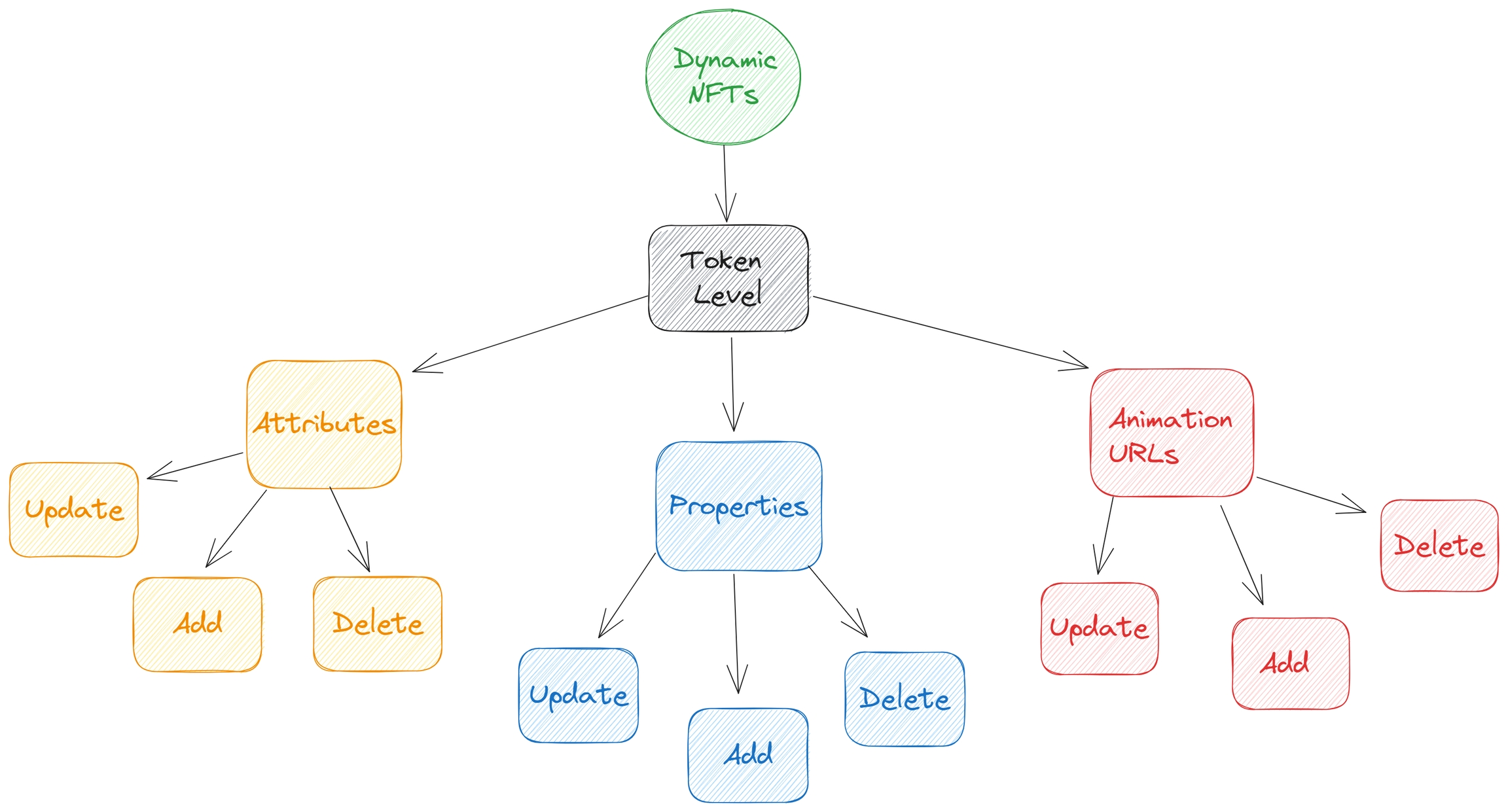
There are three basic things that you can change in an NFT.
Attributes:
Type of attribute
Name of the attribute
Attribute's value
Attribute's maximum value
Properties:
Name
Description
External Url
Image
Background Color
Animation URLs
📘
Changes made on the token-level will not affect anything on the token-type level. The token-type will have the same metadata as you defined when creating it.
If you change the metadata of the token-type, after minting an NFT, the changes will not reflect in the already minted NFT. The changes will reflect only on the new minted NFTs under that token-type.
Dynamic NFT Endpoints
Following is an example of an already-minted NFT. We will use this and update its properties, attributes, and animation URLs, all on the token level.
JSON
1. Attributes
Attributes on the token level can be updated, added, and deleted. Read more about attributes.
You can change (add, update, delete) attributes on the token-level without affecting the attributes defined on the token-type level. When you change an attribute, it is only for a specific NFT.
All NFTs minted from a token-type will include the original attribute values that were defined when you created the token-type. In short, the changes will not affect the token-type.
🚧As there can be multiple attributes, the attributes defined on the token-type level will be merged together with attributes defined on the token level.
1.1 Update Attribute
You can update an attribute's data for a specific NFT using the following endpoint.
🚧The attributes
tokenTypeId, maxSupply, mintNumbercannot be updated.
Request Endpoint: reference
HTTP
{secretType}
Path
The blockchain of the NFT collection
String
✅
{contractAddress}
Path
The NFT contract address
String
✅
{tokenId}
Path
The ID of the token you want to update
String
✅
{attributeName}
Path
The name of the attribute you want to update (NOTE: This param is case sensitive.)
String
✅
type
Body
Can be one of these: property|stat|boost
String
✅
value
Body
Value of the attribute
String
✅
maxValue
Body
Max value for the attribute
String
❌
❗️The
attributeNamein the path is case sensitive.
Example Request
📘We are going to change the values of the Health attribute. In our original minted NFT, the Health attribute had the values:
JSON
HTTP
JSON
Response Body
👍The values for the Health attribute have been changed successfully.
JSON
1.2 Add an Attribute
You can add attributes to a specific NFT using the following endpoint:
Request Endpoint: reference
HTTP
{secretType}
Path
The blockchain of the NFT collection
String
✅
{contractAddress}
Path
The NFT contract address
String
✅
{tokenId}
Path
The ID of the token
String
✅
type
Body
Can be one of these: property|stat|boost
String
✅
name
Body
The name of the attribute
String
✅
value
Body
Value of the attribute
String
✅
maxValue
Body
Max value for the attribute
String
❌
Example Request
📘In this example, we are adding a new attribute called Power to the token.
HTTP
JSON
Response Body
👍A new attribute called Power has been added successfully.
JSON
1.3 Delete an Attribute
You can delete an attribute for a specific NFT by using the following endpoint.
🚧The attributes
tokenTypeId, maxSupply, mintNumbercannot be deleted.
Request Endpoint: reference
HTTP
{secretType}
Path
The blockchain of the NFT collection
String
✅
{contractAddress}
Path
The NFT contract address
String
✅
{tokenId}
Path
The ID of the token for which you want to delete the attribute
String
✅
{attributeName}
Path
The name of the attribute you want to delete. (NOTE: This param is case sensitive.)
String
✅
❗️The
attributeNamein the path is case sensitive.
Example Request
📘In this example, we are deleting the Power attribute.
HTTP
Response Body
👍The Power attribute was deleted successfully.
JSON
2. Properties
The following properties on the token level can be updated, added, and deleted:
name(This property cannot be deleted)descriptionexternalUrlimagebackgroundColor
🚧As all the properties can only have a single value, the changes made to properties on token level will overide the properties defined on the token-type level.
2.1 Update a Property
You can update a property for a specific NFT using the following endpoint.
📘You can also use this endpoint to add a property, such as
name, description, externalUrl, image, backgroundColor.
Request Endpoint: reference
HTTP
{secretType}
Path
The blockchain of the NFT collection
String
✅
{contractAddress}
Path
The NFT contract address
String
✅
{tokenId}
Path
The ID of the token you want to update
String
✅
{propertyName}
Path
The name of the property you want to update (NOTE: This param is case sensitive.)
This can be: name, description, externalUrl, image, backgroundColor
String
✅
value
Body
Value of the property that you want to update
String
✅
Example Request
📘We are going to change the value of the
descriptionproperty. In our original minted NFT, the description property had the value:JSON
HTTP
JSON
Response Body
👍The description has been updated successfully.
JSON
2.2 Delete a Property
You can delete a property for a specific NFT by using the following endpoint.
🚧Only the
nameproperty cannot be deleted.
Request Endpoint: reference
HTTP
{secretType}
Path
The blockchain of the NFT collection
String
✅
{contractAddress}
Path
The NFT contract address
String
✅
{tokenId}
Path
The ID of the token you want to update
String
✅
{propertyName}
Path
The name of the property you want to update (NOTE: This param is case sensitive.)
This can be: description, externalUrl, image, backgroundColor
String
✅
Example Request
HTTP
Response Body
👍The description property has been deleted successfully.
JSON
3. Animation Url
The animation Urls on the token level can be updated, added, and deleted. Read about [animationUrls](https://docs.quantum.io/docs/animation-media#animationurls).
🚧
The
animationUrlsis a single array. The changes made to it on the token level will overide theanimationUrlsdefined on the token-type level.When you update the
animationUrls, you will overwrite the whole array of URLs, thus you cannot update one specific URL from the array.
3.1 Update Animation URL
You can update the animationUrls for a specific NFT using the following endpoint.
📘
This endpoint can also be used to add the
animationUrls, in case you delete them.Running this endpoint will overwrite the previous
animationUrlsarray.
Request Endpoint: reference
HTTP
{secretType}
Path
The blockchain of the NFT collection
String
✅
{contractAddress}
Path
The NFT contract address
String
✅
{tokenId}
Path
The ID of the token you want to update
String
✅
type
Body
The type of the animation media. Allowed values: image | audio | video
String
✅
value
Body
The URL of the animation media
String
✅
Example Request
📘We are going to update the
animationUrls. In our original minted NFT, theanimationUrlshad the values:JSON
HTTP
JSON
Response Body
👍The values of the animationUrls array have been updated successfully.
JSON
3.2 Delete Animation Urls
You can delete the animationUrls for a specific NFT using the following endpoint.
Request Endpoint: reference
HTTP
{secretType}
Path
The blockchain of the NFT collection
String
✅
{contractAddress}
Path
The NFT contract address
String
✅
{tokenId}
Path
The ID of the token you want to update
String
✅
Example Request
HTTP
Response Body
👍The animationUrls array has been deleted successfully.
JSON
Last updated